Friday, March 28, 2014

Vellum Images

I have been constructing images by taking pinhole images printed on vellum and gluing them over color images printed on cold press paper.  These remind me of my earlier refection work.  But the end product has more depth because of the way the image beneath the vellum seems to glow through.  they are odd pieces to construct, because it takes weeks for the methyl cellulose and white glue mixture to completely cure, making the images richer as they age through time.


The next two pieces are not completely cured, so they will eventually become richer.


New Pinhole Experimental Images


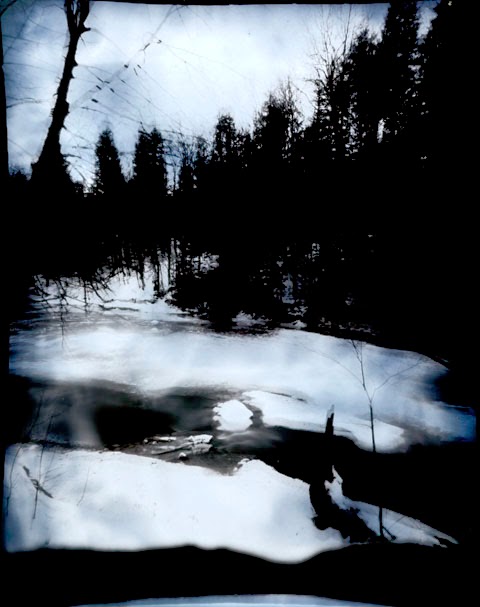
I've been experimenting further with the pinhole imagery, and have also expanded outward to include light and the landscape.

Friday, February 21, 2014

Meeting with Shellburne Sunday, February 16th

     At Shellburne's request I brought the best of the large pin-hole prints from my 2nd & 3rd semesters.  She really liked the work, and said that my fondness for my cameras was apparent.  She talked about the importance of having a good working relationship between the photographer and their equipment.  She said my pin-hole images were really my own.  She said she would love to see them bigger, because if they were closer to human scale they would really push the metaphor of the building as a stand-in for the body.
     She said she liked the way the buildings I drive by every day have become part of my own narrative.  She said I've projected pieces of me outside of myself and onto these structures as a way to understand myself better.  I was happy she said that.  These buildings really have become a part of me.  I am connected.  I call them, "My Barn" (possessive), or "The Old Man's House" (familiarity with strangers), and I worry about missing changes in their structures.  In a funny way they have become family.
     She particularly liked a couple of the pinhole images of my copper house sculpture burning.  She said it didn't matter if she knew what the images actually were of, because they conveyed a sense of transcendence through the light.  She said maybe I should look at some Tibetan texts.  She said these images are expressing a deeep need to understanding the cycle of life.  She said maybe I don't need the structure any more.  She said maybe it's time to move out of the house and into the landscape.  She said in some of my work I'm using the light as a kind of fire.  The light has the ability to illuminate an to obfuscate.  the light giveth and the light taketh away.  she said it could be interesting to end up with just light and shadows in my images. She said it would be interesting to lay out some of my pin-hole images in a narrative form, starting with the structure and then dissolving into pure light and dark.
     Then I pulled out my most recent work: Photoshop combinations of pin-hole exteriors with color interiors.  I also had  eight of these combinations physically constructed, with the printed color photo over-laid by a vellum black & white pin-hole image.  Shellburne was very excited by these.  She said she knew that the fact they were physically constructed was very important to me.  But she loved that the construction was invisible to the viewer.  She said that in a way I was constructing a painting.  She said the best of these images were elegant.  By that she said she felt they conveyed only what I was trying to say and no more.  She said to her elegance is self assurance without the ego.  And she said she believed I was too intelligent not to strive for elegance.  She said they reminded her of the reflection images I first brought her, where you couldn't tell what was inside or outside, and things were pushing backwards and forwards onto themselves.    She said I should pay attention to this, because when you start doing the same thing over and over again you have to recognize that there is something important in what you're trying to communicate.  Shellburne felt I should definitely make more of these, but to strive to have the interior and exterior images meld together.  She said neither image should compete for attention.  The two images need to be balanced so the viewer feels a sense of what's going on.

Wednesday, February 5, 2014

Monday, January 20, 2014

Test Images


1st Mentor Meeting, Sunday, January 12th

It was great to meet with Shellburne again.  She always cuts through to the essence.

Shellburne said that I should constantly re-evaluate my need to build.  She said “Less is More”, and it takes courage to just let things sit.  She said the quartets were over-kill, and the wire was too fussy and keeping the viewer from getting into the image.  She said I’m not respecting my images, and I need to get out of my own way.  She said I could try using shadow boxes to mix interiors and exteriors, the way my reflection images were both the inside and the outside.  She said the boxes themselves would have to be much more discrete, though, so the frames wouldn’t get in the way.  She said I should let the viewer bring his or her own associations.  Or she said I could think about printing my images on silk and let them float as the viewer walks by.  She was also intrigued by my experimental black and white vellum image over a color image.  She said that was worth trying more of.  She said to think of how memory, like dreams, doesn’t necessarily make sense.  She said I needed to go back and regroup, and not confuse myself.  She said I have a tremendous amount of imagery to work with, and I should spend some time composing with the computer.

January Residency

     The weather wasn't the only interesting happening at the residency.  Stacey Piwinski said it best: I came with four separate bodies of work, and I had to choose.  So with this I had four differing camps of opinion.

     The quartets should function 5 ways: each as individuals and then as a group.  In the quartets I’ve already determined what’s fractured and what’s put together.  But the photos are more ephemeral, and allow the viewer to explore and make determinations.  In the quartets things have gotten too externalized and flat.  I need to go deeper into the visual form.  The more specific things become the more general things become.  Although there were also some who loved my quartets and their fencing and wanted to see more and have them expand and grow.
     With the shadow boxes I’ve mediated what the viewer is seeing.  It is not straight on imagery.  The transparent layers provide a lot of ambiguity, as the imagery shifts as the viewer moves.  They are painterly without being a painting.  But the boxes are kind of clunky and the lights should not be in suck a straight and even line.
     Jan Avgikos said the materiality and craftiness of both the quartets and the shadow boxes disrupted and got in the way of the content.
     Robert Smithson has written a lot about materials and manifestation and entropy.
The house is not dramatic enough.  There is no emotional distance.   Nesting metaphors of house and wall are present but murky. I should challenge my approach.  The house is distance, but Kiefer is not distance.  Washy & watercolory doesn’t convey emotion.  Things have to be more unexpected.  And where are the interiors of these structures where the actual living occurred?  Where are the objects, the pieces of things people hold onto? 
     Memory and reconstruction of the past needs more than the outside of the house.  There is not enough to explore this idea.  It needs to be more nuanced.  I am showing only one side of our sense of security.  I need to branch off and explore other ramifications.  I need to describe the psychology of memory of a place.  I should spend time writing down what I miss or want from my memories.  I need to give a clear indication of what the memory is.
     Sunanda Sanyal said to frame memory in terms of the American idea of memory.  He said I should widen my view of the house, but also discuss the limitations of the house.  As an artist he said not to just look at possibilities, but also the limitations.
     Dissolution and transformation – something lost, something gained.  Find a way to imitate this process: not literally, but emotionally.  I should aspire to a lot of emotional content.
Many people liked my experimental piece with a black & white vellum image over a color image.  Deb McDuff said she liked that the best, because the vellum represented memory, and the color behind symbolized life.
     What most people liked the most were my straight pin-hole camera images of my sculptures.  Lynne Cooke said the detail in my images didn’t automatically correspond with a known process to her.  She said it adds to their mystery and ambiguity.  Assya Makawi said she loved how much clarity and detail was in my pin-hole images, and yet so much ambiguity.  She said all of my other work is a support for my pin-hole images.  Jan Avgikos said I should investigate the idea of haunted houses.